Sagging Ceiling or Just a Crack? How to Tell the Difference
Most people notice a crack long before they notice a sag. The trouble is that in a Perth brick-and-tile home, the two are often the same problem at different stages. This guide walks through what to look for, what you can check yourself in five minutes, and which signs mean it is time to get someone into the roof space.
By Ceiling Fixers Perth · Updated 3 October 2026
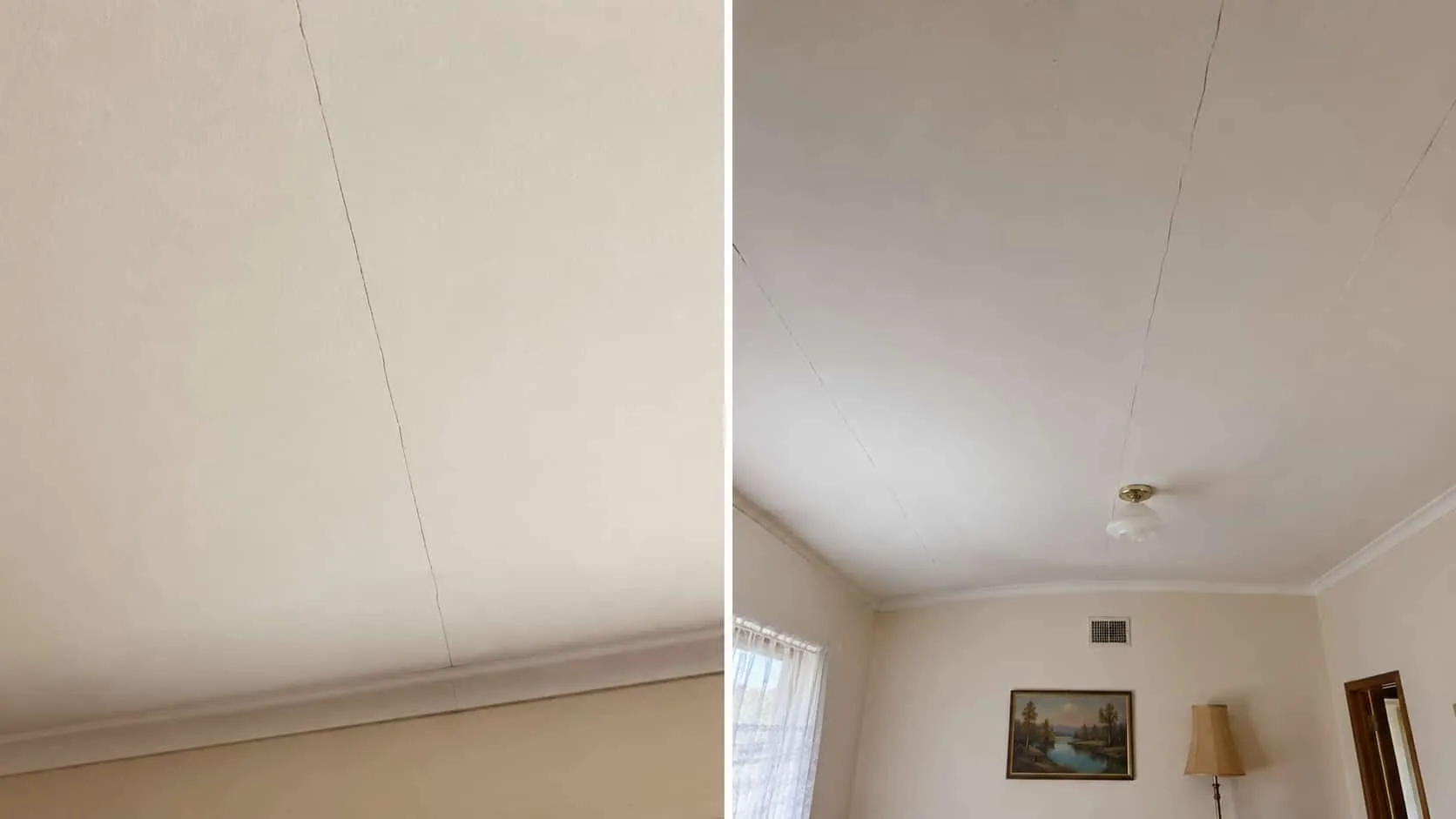
Why the distinction matters
A crack is a symptom. It tells you something has moved, but not what, how far, or whether it is still moving. A sag is a mechanical fact: part of the ceiling is no longer held where it was built to sit. Cracks on their own are usually a cosmetic job. Sag means the fixing between the ceiling sheet and the joists above it has failed somewhere, and the only thing holding that section up is whatever fixing has not failed yet.
In Perth that distinction carries extra weight, because so many homes built between the late 1950s and the mid-1980s have plasterglass ceilings. Those are sheets of fibrous plaster, glued to the joists and tied back with hessian strapping soaked in plaster. The glue and the strapping both age. When they go, the sheet does not fall in one hit. It drops a few millimetres, cracks along the nearest join or cornice, and keeps dropping. So a crack that appears on an older ceiling deserves a second look that a crack on a modern plasterboard ceiling might not.
What surface cracking looks like
Cosmetic cracks have a few things in common. They are usually fine, hairline or close to it, and they tend to follow a straight line because they are sitting on a sheet join or along the line of the cornice. They are often the same width along their whole length. Run a straight edge or a long spirit level across the ceiling next to the crack and it will sit flat on both sides.
Common causes are the house settling, seasonal movement of timber as it dries out through a Perth summer and takes up moisture again in winter, a two-storey home flexing slightly, or the set coat on a plasterboard join shrinking over time. In a newer home, a crack along a sheet join in the first couple of years is often just the joint compound curing and the frame finding its final position.
- Hairline, consistent width, follows a join or the cornice line
- Ceiling is flat on both sides of the crack when checked with a straight edge
- Has not changed noticeably in months
- No stain, no soft spot, no change in the sound when you tap it
What sag looks like, even when it is subtle
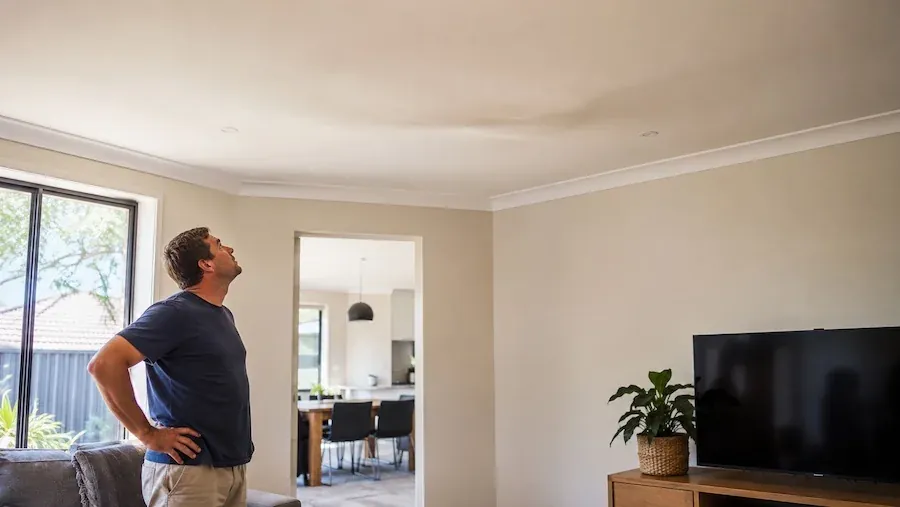
Sag is easiest to see with the lights off and a torch held flat against the ceiling, shining across it rather than up at it. Any dip shows as a shadow. You can also stand in the doorway and sight along the ceiling towards the far wall. A healthy ceiling reads as a flat plane right into the cornice. A sagging one has a belly in it, often in the middle of the largest span, or a dropped edge along one wall where the cornice has pulled away.
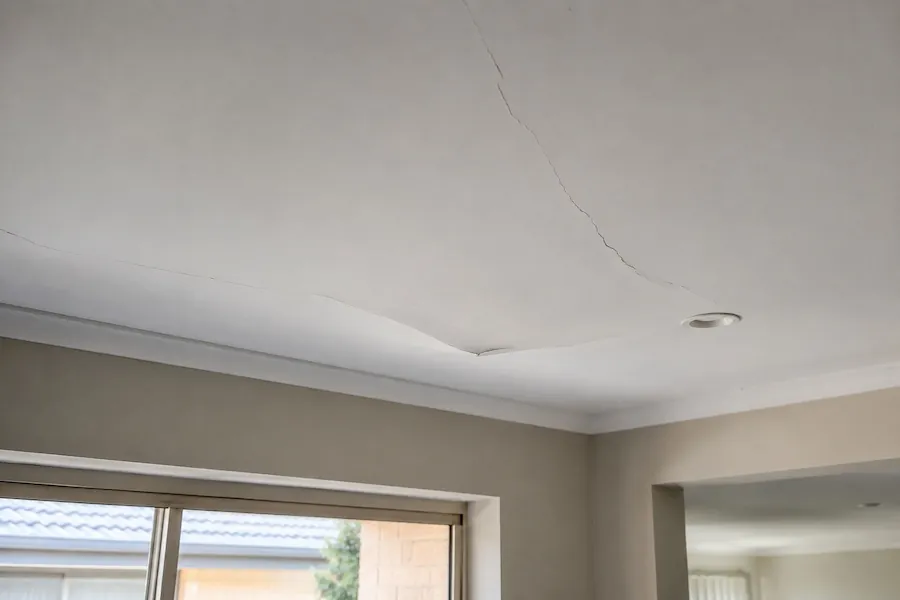
The cracks that come with sag behave differently from cosmetic ones. They tend to be wider in the middle than at the ends, because the sheet is bowing rather than just shrinking. A crack that runs along the top of the cornice and is visibly open, with a shadow line inside it, usually means the ceiling has dropped and the cornice has stayed where it was. You may also see a row of small bumps or dimples where the sheet has pulled down over the original fixings, or a line of fresh cracks radiating out from a light fitting.
A sagging plasterglass ceiling also sounds different. Tap a well-fixed section with your knuckle and it is a short, dull knock. Tap a section that has come away from the joists and it is hollow and slightly resonant, because you are tapping a sheet that is hanging unsupported.
- Visible dip or belly when sighted along the ceiling or raked with a torch
- Crack is open, with a shadow line, often wider in the middle
- Gap opening between ceiling and cornice
- Hollow sound when tapped, dimpling over fixings, cracks around light fittings
A five-minute check you can do yourself
First, photograph the crack with something in frame for scale, a coin or a tape measure, and note the date. Repeat in a month. Growth is the single most useful piece of information you can give anyone who comes to look at it. Second, do the torch test described above. Third, tap gently around the crack and listen for the change in sound. Fourth, look for anything else nearby: a water stain, a soft or discoloured patch, a sheet join that has opened, or a cornice that has pulled away from either the wall or the ceiling.
If the roof space is accessible and you are comfortable up there, a look from above is worth more than any of this. Do not walk on the ceiling, only on the joists or on a board laid across them. Look for strapping that has snapped or pulled through, glue daubs that have separated from the sheet, daylight through the tiles, or signs of water or termites. If you are not comfortable in a roof space, leave it. It is hot, dark and easy to put a foot through, and it is exactly the thing you are paying a ceiling fixer to do.
When a crack is more than a crack
Treat a crack as a sag until proven otherwise if any of the following are true. The house has a plasterglass ceiling, which in Perth usually means it was built before about 1985 and has a slightly textured or very smooth, heavy-looking ceiling with a set cornice rather than a paper-faced plasterboard cornice. The crack has grown in the last few weeks. There is a water stain anywhere on the same ceiling. The crack runs around a light fitting or ceiling fan. There has been recent work in the roof space, such as insulation, ducted air conditioning, solar cabling or a new whirlybird, because people walking on or dragging gear across old ceilings is one of the most common triggers for a sheet letting go.
If a section of ceiling has visibly dropped more than a couple of centimetres, or you can push it up with a broom handle and feel it move, stop using the room until it is looked at. The guide on ceiling collapse warning signs covers what to do in that situation.
How each one gets fixed
Genuine cosmetic cracks are raked out, filled, set and sanded, with any join tape replaced where it has lifted. It is a small job and the only real variable is how many there are and whether the ceiling has a texture that needs to be matched. Ceiling crack repair covers what that involves.
Sag is a different job. The ceiling is re-fixed from above where the roof space allows it, with new fixings through the sheet into the joists and fresh strapping where the old has failed, then the surface is pulled back up, the cracks are made good and the whole thing is set and sanded ready for paint. Where the sheet has deteriorated too far, or has been wet, re-fixing is not worth doing and the section is replaced. Sagging ceiling repair explains how that decision gets made on site.