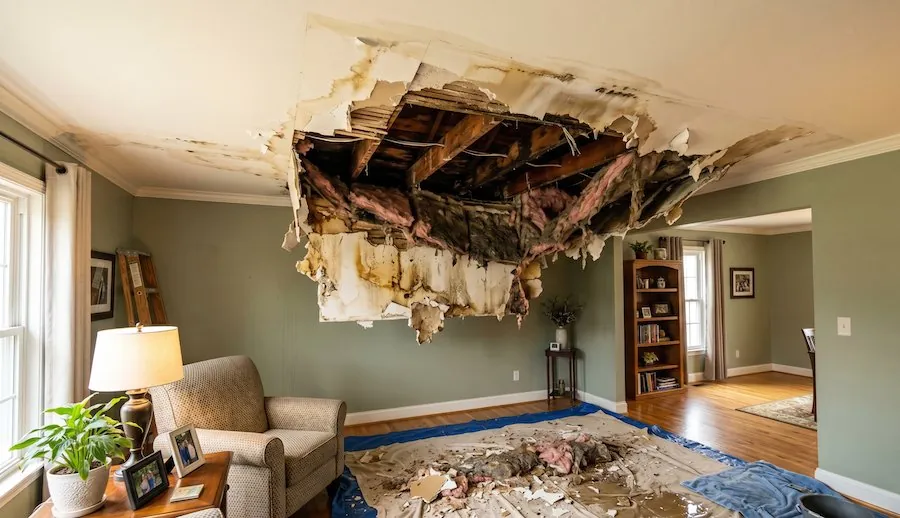
Ceiling Collapse Warning Signs You Should Not Ignore
A ceiling coming down is loud, messy and dangerous, and in Perth it is far more common than most people assume because of how many plasterglass ceilings are still in service. The good news is that they almost always give warning first. This guide lists the signs that matter, in roughly the order they tend to appear, and tells you exactly what to do if you are seeing them right now.
By Ceiling Fixers Perth · Updated 3 October 2026
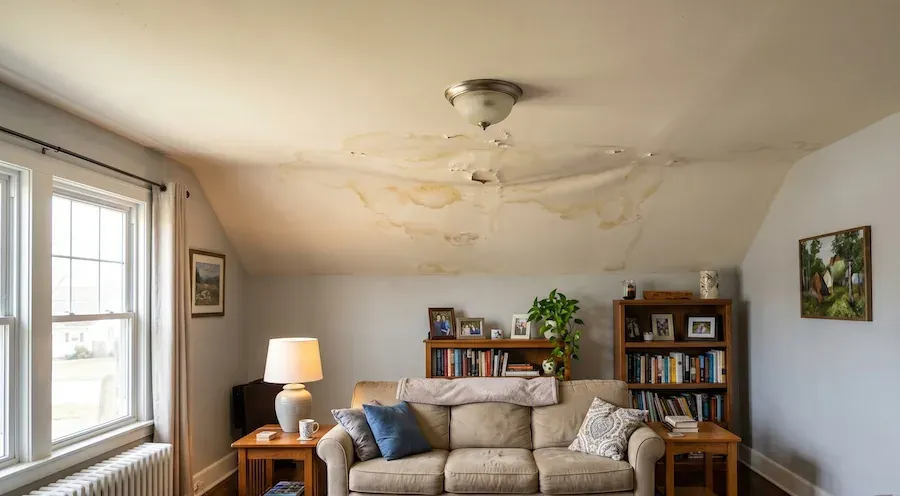
If you think it is about to come down, do this now
Get everyone, including pets, out of the room and keep them out. Close the door. Do not push, poke or tap the sagging section, and do not try to prop it with a broom or a piece of timber, because a prop pushed into a failing sheet is as likely to bring it down as hold it up. If there is water involved, or the ceiling has dropped around a light fitting or fan, switch that circuit off at the switchboard. Move anything valuable or hard to replace out of the room if you can do so without standing under the worst of it.
Then call. Describe what you are seeing: how far it has dropped, how big the area is, whether it is wet, and whether it is getting worse by the hour. That is enough for a ceiling fixer to tell you whether it needs someone there today or can be made safe and looked at properly in the next few days. Emergency ceiling repair covers what happens next. Call 0485 084 943 if you are in Perth and want someone to talk it through.
- Clear the room, close the door, keep kids and pets out
- Do not prod, prop or push the ceiling
- Switch off the lighting circuit if water or fittings are involved
- Photograph it from the doorway for your own records
- Call and describe what you can see
Sign one: a visible sag or bow
This is the one that matters most. Stand in the doorway and sight along the ceiling, or hold a torch flat against it and look for shadow. Any belly in the middle of the room, or a dropped edge along one wall, means the fixings have failed in that area and the sheet is hanging on what is left. A sag of a centimetre or two that has been stable for years is a repair job. A sag that has appeared recently, or has got worse since you last looked, is the ceiling telling you the remaining fixings are going one by one.
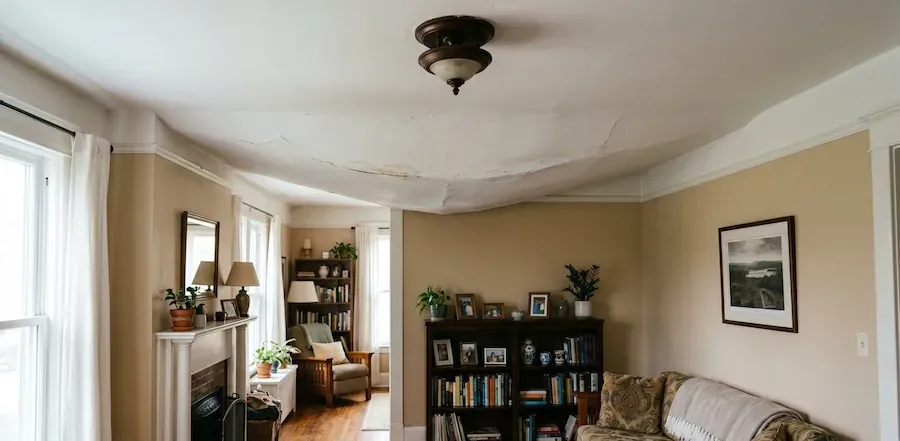
Pay particular attention to large rooms. A lounge or family room with a span of four or five metres is where plasterglass ceilings fail most dramatically, because the sheet is heavy and once it starts to drop its own weight does the rest.
Sign two: cracks that follow the cornice, and cracks that grow
When a ceiling drops, the cornice usually stays put because it is fixed to the wall. The result is a crack along the top edge of the cornice that opens into a visible gap with a shadow inside it. That gap is the amount the ceiling has moved. If you can slide a business card into it, the ceiling has dropped. If you can get a finger in, it has dropped a lot.
Cracks across the field of the ceiling that are wider in the middle than the ends, that radiate out from a light fitting, or that were hairline last month and are now obvious from the doorway are all movement cracks rather than cosmetic ones. Date a photo of them and compare in a week. Growth is the clearest evidence you can have. The guide on sagging versus cracking goes into how to read them.
Sign three: noises
People describe it as creaking, ticking, cracking or a sharp pop, usually at night or when the house is quiet, and often during a hot afternoon or as the house cools in the evening. What you are hearing is a strap snapping or a glue daub letting go and the sheet settling onto the next fixing. Timber houses creak for all sorts of harmless reasons, but a ceiling that has started making noises it did not make before, in a room where you can also see a crack or a dip, is not harmless.
Sign four: a line of bumps, dimples or popped fixings
On plasterglass, a sheet that has dropped will sometimes hang up on its original nails, producing a line of small raised bumps or dimples where the sheet is pulling down over the nail heads. On plasterboard, the same movement pops the screws or nails through the paper face in a row along the joist. Either way, a straight row of bumps across the ceiling is the sheet sliding off its fixings, and it is usually a bit further along than the owner thinks.
Sign five: water, bulging and softness
A ceiling that has been wet is the one most likely to come down in a single piece rather than sag gradually. Wet plaster loses its strength, the straps and glue let go, and the insulation above fills with water and adds weight. A bulge in a stained area is water or soft plaster hanging in the sheet. A stained area that feels soft or spongy when pressed gently with a fingertip, or sounds dull and dead rather than solid, has already lost its structure.
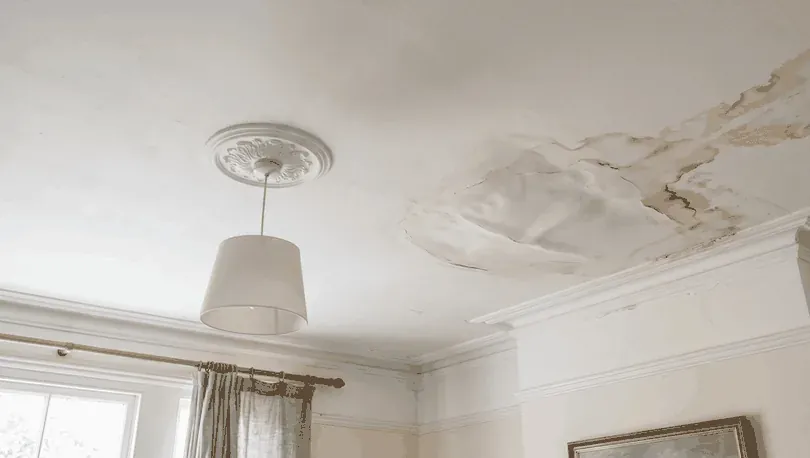
If the ceiling is wet and sagging, the leak above is still live or has only just stopped, and the full weight of soaked insulation is sitting on a sheet that is no longer properly fixed. Treat that as urgent. Clear the room and get the source stopped. What to do about a ceiling water stain covers finding the leak.
Sign six: previous repairs failing
A patch that has cracked around its edges, a filled cornice gap that has reopened, a re-fixed area where the screw heads are now visible as dimples, or a painted-over stain bleeding through: these all mean the earlier fix treated the symptom. A ceiling that has already been repaired once and is moving again has usually never been properly re-fixed, and the original cause is still there.
What is not usually an emergency
A single hairline crack on a flat ceiling, a cornice join that has opened a millimetre at the corner, or a small dry stain that has not changed in a year are repairs, not emergencies. Fine cracks in a house less than five years old are usually settling. What turns any of these into something urgent is change: growth, a new dip, a noise, or water. If nothing is changing, book it in when convenient. If something is changing, do not wait.
After it comes down
If the worst has happened, stay out of the room until the dust settles and keep the door closed, because the dust from an old plaster ceiling is unpleasant and, in homes built before about 1990, the ceiling or the material above it may contain asbestos. Do not sweep or vacuum it up with a household vacuum. A qualified asbestos assessor can test a sample before anything is disturbed if there is any doubt about the age of the home. The rest of the ceiling in that room, and often the adjoining rooms, needs to be checked, because the same fixings and the same conditions apply to all of it.